Gridfinity Dimensions: Every Size, From the 42 mm Grid to the Magnet Holes
Every Gridfinity dimension in mm and inches: the 42 mm grid, 41.5 mm bins, 7 mm heights, the 4.4 mm lip, 6 x 2 mm magnets, and how to size a drawer.
By Depthue Lab11 min read
A Gridfinity grid unit is 42 x 42 mm and a height unit is 7 mm. Three more numbers set the fit: a bin is 0.5 mm smaller than its grid, it stands on feet 4.75 mm tall, and the stacking lip adds 4.4 mm on top.
Gridfinity dimensions at a glance
| Part | Dimension | Notes |
|---|---|---|
| Grid unit | 42 x 42 mm | The spacing of baseplate cells and bins |
| Bin outline | 42 mm per unit, minus 0.5 mm | 41.5 mm for 1 unit, 83.5 mm for 2 |
| Bin corners | 3.75 mm radius | 7.5 mm across |
| Height unit | 7 mm | Counted from the bottom of the feet, lip not included |
| Foot | 4.75 mm tall | 0.8 mm at 45°, 1.8 mm straight, 2.15 mm at 45° |
| Foot bottom | 35.6 mm square | Per unit |
| Floor | 7 mm above the bottom of the feet | The top of the base |
| Stacking lip | 4.4 mm tall | 0.7 mm at 45°, 1.8 mm straight, 1.9 mm at 45° |
| Baseplate cell | 42 x 42 mm, 5 mm tall | 4 mm outer corner radius, open underneath |
| Baseplate socket | 4.65 mm profile on a 0.35 mm step | 0.7 mm at 45°, 1.8 mm straight, 2.15 mm at 45° |
| Magnets | 6 mm across, 2 mm thick | Four per grid unit |
| Magnet holes | 6.5 mm across, 2.4 mm deep | One under each corner of each unit |
| Screw holes | M3, 3 mm across | Same positions as the magnets |
| Hole centres | 8 mm in from each cell edge | 26 mm apart. The reference sheet gives 4.8 mm from the foot's bottom edge, the same point |
Every value in this table is on the gridfinity.xyz design reference or in the MIT-licensed gridfinity-rebuilt-openscad code, and most are in both. The 6 mm magnet size is only on the reference page. The 2.4 mm hole depth and the 0.35 mm step are only in the code. The reference page and the code are linked under Sources.
Three of these numbers trip people up:
- A bin is 41.5 mm, not 42. The 0.5 mm comes off the whole bin once, not off each unit: a 2 unit bin is 83.5 mm, not 83.
- A plain baseplate adds no height. The bin's feet sink through the 5 mm plate to the drawer floor.
- The lip narrows the opening. With the lip on, a 1 x 1 bin takes things up to 36.3 mm across, not 41.5.
The grid: 42 mm squares, 41.5 mm bins
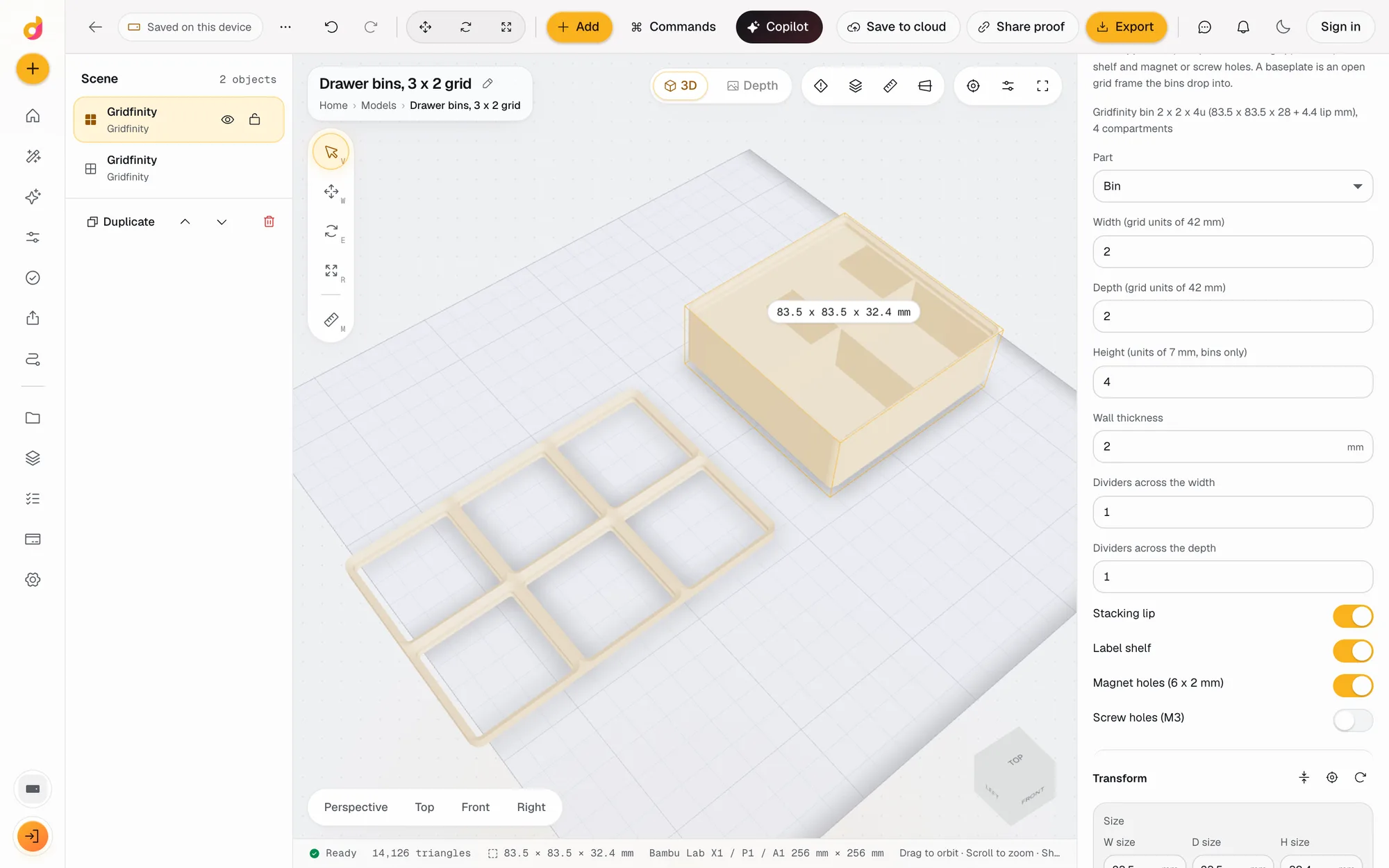
Baseplates are exactly 42 mm per cell. Bins are 0.5 mm smaller than the space they fill, so they drop in and lift out without binding. A 3 x 2 bin is 125.5 x 83.5 mm.
Bin and baseplate sizes from 1 to 10 units
| Units | Bin | Bin (in) | Baseplate | Baseplate (in) |
|---|---|---|---|---|
| 1 | 41.5 mm | 1.63 | 42 mm | 1.65 |
| 2 | 83.5 mm | 3.29 | 84 mm | 3.31 |
| 3 | 125.5 mm | 4.94 | 126 mm | 4.96 |
| 4 | 167.5 mm | 6.59 | 168 mm | 6.61 |
| 5 | 209.5 mm | 8.25 | 210 mm | 8.27 |
| 6 | 251.5 mm | 9.90 | 252 mm | 9.92 |
| 7 | 293.5 mm | 11.56 | 294 mm | 11.57 |
| 8 | 335.5 mm | 13.21 | 336 mm | 13.23 |
| 9 | 377.5 mm | 14.86 | 378 mm | 14.88 |
| 10 | 419.5 mm | 16.52 | 420 mm | 16.54 |
There is no gap between baseplate cells
Neighbouring cells share one wall, and the outside has no extra border. A baseplate is 42 mm times the cell count with nothing added: a 5 x 5 plate is 210 x 210 mm. The 0.5 mm of clearance lives on the bin, not between the cells.
What fits inside a bin
The inside is the outside minus two walls. The stacking lip leans in 2.6 mm from each side at its narrowest point, which is the top of the wall. So anything you drop in from above must be 5.2 mm narrower than the bin's outside. Turn the lip off when a part needs the full width.
| Units | Inside, 1.2 mm walls | Opening under the lip |
|---|---|---|
| 1 | 39.1 mm | 36.3 mm |
| 2 | 81.1 mm | 78.3 mm |
| 3 | 123.1 mm | 120.3 mm |
| 4 | 165.1 mm | 162.3 mm |
| 5 | 207.1 mm | 204.3 mm |
| 6 | 249.1 mm | 246.3 mm |
The inside column uses 1.2 mm walls, the default in Depthue's generator. For other walls, take the bin size and subtract twice the wall.
Heights in 7 mm units
Height counts 7 mm units from the bottom of the feet, base included and lip not included. A 3 unit bin is 21 mm to the top of its wall, and 25.4 mm with the stacking lip. The 2 x 2 bin in the picture at the top is 4 units tall: 28 mm to the wall, 32.4 mm with its lip.
| Units | To the wall top | With lip | With lip (in) | Floor to wall top |
|---|---|---|---|---|
| 2 | 14 mm | 18.4 mm | 0.72 | 7 mm |
| 3 | 21 mm | 25.4 mm | 1.00 | 14 mm |
| 4 | 28 mm | 32.4 mm | 1.28 | 21 mm |
| 5 | 35 mm | 39.4 mm | 1.55 | 28 mm |
| 6 | 42 mm | 46.4 mm | 1.83 | 35 mm |
| 8 | 56 mm | 60.4 mm | 2.38 | 49 mm |
| 10 | 70 mm | 74.4 mm | 2.93 | 63 mm |
| 12 | 84 mm | 88.4 mm | 3.48 | 77 mm |
| 15 | 105 mm | 109.4 mm | 4.31 | 98 mm |
| 20 | 140 mm | 144.4 mm | 5.69 | 133 mm |
How deep a bin is inside
The floor sits on top of the 7 mm base, so the usable depth is one unit less than the height: 7 mm x (units minus 1). A 3 unit bin holds 14 mm to the top of its wall.
With the lip on, Depthue's generator puts a 45 degree support under the lip so it prints without supports. With 1.2 mm walls that support starts 1.4 mm below the wall top.
Stacking bins
Set one bin on another bin's lip and its feet nest inside the lip, about 0.35 mm below the lower bin's wall top. So a stack is the sum of the units times 7 mm, plus 4.4 mm if the top bin has a lip, less about 0.35 mm for each bin that sits on another. Two 3 unit bins with lips stand about 46 mm: 21 mm, plus 25.4 mm, less the 0.35 mm the top one sinks in.
The stacking figure and the baseplate rule below are worked out from the published profiles, not measured on a printed bin.
The foot, the socket and the lip
Three profiles do all the locating. They use the same 45 degree faces, which is why a bin seats the same way in a baseplate and on top of another bin.
| Profile | From the bottom up | Height |
|---|---|---|
| Bin foot | 0.8 mm at 45°, 1.8 mm straight, 2.15 mm at 45° | 4.75 mm |
| Baseplate socket | 0.35 mm straight, then 0.7 mm at 45°, 1.8 mm straight, 2.15 mm at 45° | 5 mm |
| Stacking lip | 0.7 mm at 45°, 1.8 mm straight, 1.9 mm at 45° | 4.4 mm |
The foot's flat bottom is 35.6 mm square: the 41.5 mm outline less 2.95 mm on each side. Above the foot, the bin runs straight up at its full outline. The lip ends in a small tip, a 0.6 mm flat in Depthue's generator and a 0.6 mm rounded edge in gridfinity-rebuilt. The bin seats on the 45 degree faces.
Why a plain baseplate adds no height
Lower a bin into a socket and its 45 degree faces meet the socket's 45 degree faces when the bottom of the bin is 5 mm below the top of the rim. A plain baseplate is 5 mm tall and open underneath. So the feet reach the drawer floor, and the plate adds nothing to the height of the bin.
Depthue's baseplate makes each socket 0.025 mm tighter per side, so bins stand 0.025 mm up.
A baseplate with a solid floor is different. On a magnet or weighted plate the bin stands on that floor, so add its thickness.
The height rule: clear height needed = 7 mm x units, plus 4.4 mm for a lip, plus the baseplate's floor if it has one, plus 1 to 2 mm to spare. A common rule subtracts 5 mm for the baseplate as well. With a plain plate that 5 mm is spare room. Keep it as a margin if you would rather not test.
Magnets and screws
6 x 2 mm magnets in 6.5 x 2.4 mm holes
Gridfinity uses 6 mm x 2 mm disc magnets, four per grid unit, one under each corner of each foot. The design reference asks for holes in all four corners of every unit, so a bin works in any rotation.
The standard hole is 6.5 mm across and 2.4 mm deep: 0.5 mm wider and 0.4 mm deeper than the magnet. A 6 mm magnet sits loose in that hole, which is why magnets drop out. Put a drop of glue in each hole. When both the bin and the baseplate carry magnets, check which way each one faces before the glue sets, or the bin will push away instead of pulling in.
gridfinity-rebuilt also offers press-fit options: holes 5.86 mm across, smaller than the magnet so it is squeezed in, and crush ribs. Depthue's generator makes the standard 6.5 mm hole only.
Where the holes go
Each hole centre is 8 mm in from the edge of its 42 mm grid cell, which is 7.75 mm in from the bin's outside wall. That puts the centres 13 mm from the middle of the cell and 26 mm apart.
M3 screws
The same four positions take M3 screws through 3 mm holes, for bins that should never move. Depthue's generator makes them 6 mm deep.
How to measure a drawer for Gridfinity
- Empty the drawer and measure the inside width and depth at the floor. Slides, lips and rounded corners take room there.
- Measure in two or three places and keep the smallest number.
- Subtract 1 mm, divide by 42 and round down. That is the grid, in units.
- Measure the clear height from the drawer floor to the lowest thing above it with the drawer closed.
- Print one small bin and a small baseplate before the full set, and check the fit.
Drawers in inches
| Drawer inside | Units | Grid | Left over |
|---|---|---|---|
| 4 in (101.6 mm) | 2 | 84 mm | 17.6 mm |
| 6 in (152.4 mm) | 3 | 126 mm | 26.4 mm |
| 8 in (203.2 mm) | 4 | 168 mm | 35.2 mm |
| 10 in (254 mm) | 6 | 252 mm | 2 mm |
| 11 in (279.4 mm) | 6 | 252 mm | 27.4 mm |
| 12 in (304.8 mm) | 7 | 294 mm | 10.8 mm |
| 14 in (355.6 mm) | 8 | 336 mm | 19.6 mm |
| 15 in (381 mm) | 9 | 378 mm | 3 mm |
| 16 in (406.4 mm) | 9 | 378 mm | 28.4 mm |
| 18 in (457.2 mm) | 10 | 420 mm | 37.2 mm |
| 20 in (508 mm) | 12 | 504 mm | 4 mm |
| 22 in (558.8 mm) | 13 | 546 mm | 12.8 mm |
| 24 in (609.6 mm) | 14 | 588 mm | 21.6 mm |
| 30 in (762 mm) | 18 | 756 mm | 6 mm |
Drawers in millimetres
| Drawer inside | Units | Grid | Left over |
|---|---|---|---|
| 300 mm | 7 | 294 mm | 6 mm |
| 350 mm | 8 | 336 mm | 14 mm |
| 400 mm | 9 | 378 mm | 22 mm |
| 450 mm | 10 | 420 mm | 30 mm |
| 500 mm | 11 | 462 mm | 38 mm |
| 600 mm | 14 | 588 mm | 12 mm |
"Left over" is the whole gap, shared between the two sides.
Height to the tallest bin
With a plain baseplate and 1 mm to spare, the tallest bin is the clear height minus 1 mm, divided by 7 and rounded down. With a lip, subtract 5.4 mm first.
| Clear height | Tallest bin with lip | Tallest bin without lip |
|---|---|---|
| 25.4 mm (1 in) | 2 units | 3 units |
| 38.1 mm (1.5 in) | 4 units | 5 units |
| 50.8 mm (2 in) | 6 units | 7 units |
| 60 mm | 7 units | 8 units |
| 76.2 mm (3 in) | 10 units | 10 units |
| 101.6 mm (4 in) | 13 units | 14 units |
What to do with the leftover
Centre the grid and split the gap between both sides, or print filler strips to the exact width. Do not scale the grid up to fill the drawer. At anything but 42 mm, no standard bin or baseplate fits it.
Which baseplate fits your printer bed
Divide the bed by 42 and round down, and leave a few millimetres for a skirt or brim.
| Printer | Bed (X x Y) | Largest baseplate |
|---|---|---|
| Bambu Lab A1 mini | 180 x 180 mm | 4 x 4 (168 mm) |
| Creality Ender-3 V3 SE | 220 x 220 mm | 5 x 5 (210 mm) |
| Prusa MK4S | 250 x 210 mm | 5 x 4 (210 x 168 mm) |
| Prusa CORE One | 250 x 220 mm | 5 x 5 (210 mm) |
| Bambu Lab A1 | 256 x 256 mm | 6 x 6 (252 mm) |
| Bambu Lab P1 and X1 series | 256 x 256 mm | 6 x 5 (252 x 210 mm) |
Bed sizes are the makers' published build volumes. On the MK4S a 5 x 5 is exactly the 210 mm depth of the bed, so check it in the slicer before you count on it. On the X1 and P1 series, Bambu keeps the print head out of an 18 x 28 mm area in the front left corner, where the filament cutter's stopper sits, so a 252 mm square will not fit on a stock printer. A 6 x 5 fits.
Grid bigger than your bed? Print it in pieces. Each piece is exactly 42 mm per cell on the outside, so a 4 x 4 and a 2 x 4 sit side by side as a 6 x 4.
Make bins and baseplates to these numbers
The free Gridfinity generator builds bins and baseplates to every number in the table at the top of this page. Set the size in grid units, from 1 x 1 to 10 x 10 and 2 to 20 units tall. Add dividers, a stacking lip, a label shelf, magnet holes or M3 holes, and download a watertight STL or 3MF. No account, and the file is made on your computer.
Its tests measure the built solid against the standard: a 2 x 1 bin comes out 83.5 x 41.5 mm, the floor sits at 7 mm, the foot is 35.6 mm square at the bottom, and a 3 x 2 baseplate is 126 x 84 x 5 mm. It makes the plain open baseplate. It does not make magnet or weighted baseplates, half-unit bins or drawer spacers.
Bins and baseplates print flat with no supports, and PLA or PETG both work. To check a download, open it in the STL viewer and read the size. To price a drawer of bins, drop each STL into the 3D print cost calculator.
For a name on the front, a slot shaped like one tool, or two parts joined into one, make the bin in Depthue Studio. A free account comes with 50 credits a month.
Free tools for this job
Frequently asked questions
What is the standard Gridfinity size?
One grid unit is 42 x 42 mm and one height unit is 7 mm. Standard bins come in whole units of both, so a 2 x 1 bin, 3 units tall, is 83.5 x 41.5 x 21 mm before the stacking lip.
Is a Gridfinity bin 42 mm or 41.5 mm?
A one unit bin is 41.5 mm. The grid is 42 mm per unit and the bin loses 0.5 mm once, across the whole bin, so 2 units is 83.5 mm and 3 units 125.5 mm. Baseplates are exactly 42 mm per cell.
How tall is a Gridfinity bin?
7 mm per height unit, measured from the bottom of the feet, with the floor 7 mm up. A 3 unit bin is 21 mm to the top of the wall, and the stacking lip adds 4.4 mm.
Does the baseplate add to the height?
A plain open baseplate adds nothing: the bin's feet sink through the 5 mm plate to the drawer floor. A baseplate with a solid floor, such as a magnet or weighted plate, adds the thickness of that floor.
What size magnets does Gridfinity use?
6 x 2 mm disc magnets, four per grid unit. The standard holes are 6.5 mm across and 2.4 mm deep, a little larger than the magnet, so plan on a drop of glue in each.
How do I measure a drawer for Gridfinity?
Measure the inside width and depth at the floor, keep the smallest reading, subtract 1 mm, divide by 42 and round down. For height, take the clear height, subtract 1 mm (5.4 mm if the bin keeps its lip), divide by 7 and round down.
What size Gridfinity baseplate fits my printer?
Divide the bed by 42 and round down: 4 x 4 on a 180 mm bed, 5 x 5 on a 220 mm bed and 6 x 6 on a 256 mm bed when all of it is printable. Print bigger grids in pieces that sit side by side.
What are the Gridfinity dimensions in inches?
One grid unit is 1.65 in and a 1 x 1 bin is 1.63 in. A height unit is 0.28 in and the stacking lip adds 0.17 in.
Who created Gridfinity?
Zack Freedman, who introduced it in a YouTube video published on April 13, 2022.
Sources
- Gridfinity specification and design reference (willtree8)
- gridfinity-rebuilt-openscad, standard.scad
- gridfinity-rebuilt-openscad, gridfinity-baseplate.scad
- Zack Freedman, Gridfinity: Your Ultimate Modular Workshop is FREE! (YouTube, 2022)
- Bambu Lab A1 mini tech specs
- Bambu Lab A1 tech specs
- Bambu Lab X1 Carbon technical specifications (PDF)
- Bambu Lab Wiki, Print volume limitations
- Creality, Compare Ender-3 V3 series
- Prusa Research, Original Prusa MK4S
- Prusa Research, Prusa CORE One