
Depthue Studio
Gridfinity generator: bins and baseplates in your browser
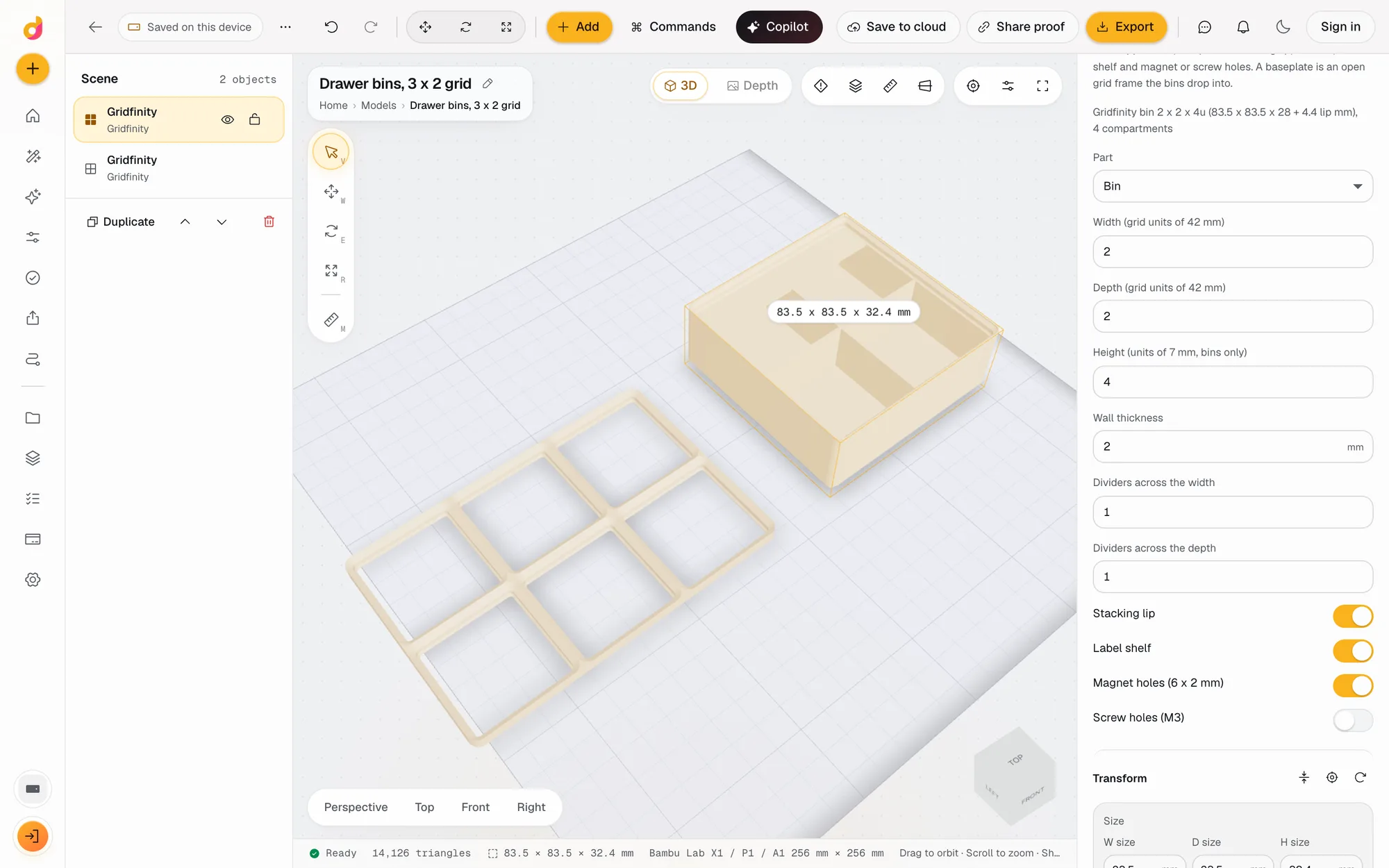
The Depthue Studio Gridfinity generator builds bins and baseplates to the open Gridfinity standard: a 42 mm grid, 7 mm height units and the stepped foot that drops into any Gridfinity baseplate. Set the size, dividers, stacking lip, label shelf and magnet or screw holes, and export a closed STL or 3MF. It runs in your browser and it is free.
Free in your browser, no card. Files stay on your device until you save to the cloud.
The short answer
- Bins from 1 x 1 to 10 x 10 grid units and 2 to 20 height units (14 to 140 mm), and open baseplates from 1 x 1 to 10 x 10.
- Dividers in both directions, a stacking lip, a label shelf, 6 x 2 mm magnet holes and M3 screw holes are switches.
- Every bin is one closed solid built to the published Gridfinity dimensions, ready for any slicer as STL or 3MF.
- Standard
- Gridfinity: 42 mm grid pitch, 7 mm height units, bins 0.5 mm under the grid
- Bin size
- 1 to 10 grid units wide and deep (41.5 to 419.5 mm)
- Bin height
- 2 to 20 units of 7 mm (14 to 140 mm), plus 4.4 mm for the stacking lip
- Walls
- 0.8 to 2.4 mm, 1.2 mm by default
- Dividers
- 0 to 9 across the width and 0 to 9 across the depth, 1.2 mm thick
- Options
- Stacking lip, label shelf, magnet holes (6.5 mm across, 2.4 mm deep), M3 screw holes
- Baseplate
- 1 to 10 cells each way, 42 mm a cell, 5 mm tall, open underneath
- Export
- STL, 3MF, OBJ, GLB or PLY
How to make a Gridfinity bin
- 1
Add a bin
Open the Gridfinity generator, or Add, Gridfinity in any project. A 2 x 1 bin, 3 units tall, lands on the plate.
- 2
Size it to the drawer
Set the width and depth in 42 mm grid units and the height in 7 mm units. The inspector shows the real size in mm as you type.
- 3
Split it and label it
Add dividers across the width or depth, a label shelf on the back wall, and magnet or screw holes under the feet.
- 4
Add the baseplate and export
Switch Part to Baseplate for the grid the bins sit in, then Export STL or 3MF and print both.
Built to the Gridfinity numbers
Gridfinity works because every part shares the same few numbers. Studio uses the dimensions from the open Gridfinity wiki and the MIT-licensed gridfinity-rebuilt-openscad reference, and the generator's tests measure them on the built solid.
| Part of the bin | Size |
|---|---|
| Grid pitch | 42 mm |
| Bin outline | 41.5 mm per unit (0.5 mm under the grid), 3.75 mm corners |
| Foot profile | 0.8 mm at 45°, 1.8 mm straight, 2.15 mm at 45° |
| Floor | 7 mm above the bottom of the foot |
| Height unit | 7 mm |
| Stacking lip | 4.4 mm: 0.7 mm at 45°, 1.8 mm straight, 1.9 mm at 45° |
| Magnet holes | 6.5 mm across, 2.4 mm deep, 8 mm in from each unit's sides |
| Baseplate | 42 mm a cell, 5 mm tall, 4 mm outer corners |
The lip has a 45 degree support under it, so a bin prints without supports, and dividers stop under the lip so a stacked bin still seats.
Bins for what you store
- Dividers split the inside into equal compartments in both directions. A 2 x 2 bin with one divider each way gives four pockets about 40 mm square.
- Label shelf adds a ledge up to 13 mm deep along the back wall, sloped at 36 degrees underneath, for a printed or written label.
- Magnet holes sit at the four corners of every unit, for 6 x 2 mm magnets, so bins hold to a baseplate with magnets or to a steel sheet.
- Screw holes are 3 mm across for M3 screws, if you fix bins in place.
- Wall thickness goes from 0.8 mm (two lines with a 0.4 mm nozzle) to 2.4 mm for heavy tools.
Settings that will not print well are flagged instead of failing silently: compartments narrower than 8 mm come back as a plain warning, and a bin under 2 height units, which has no room inside, is explained rather than built.
Then make it yours
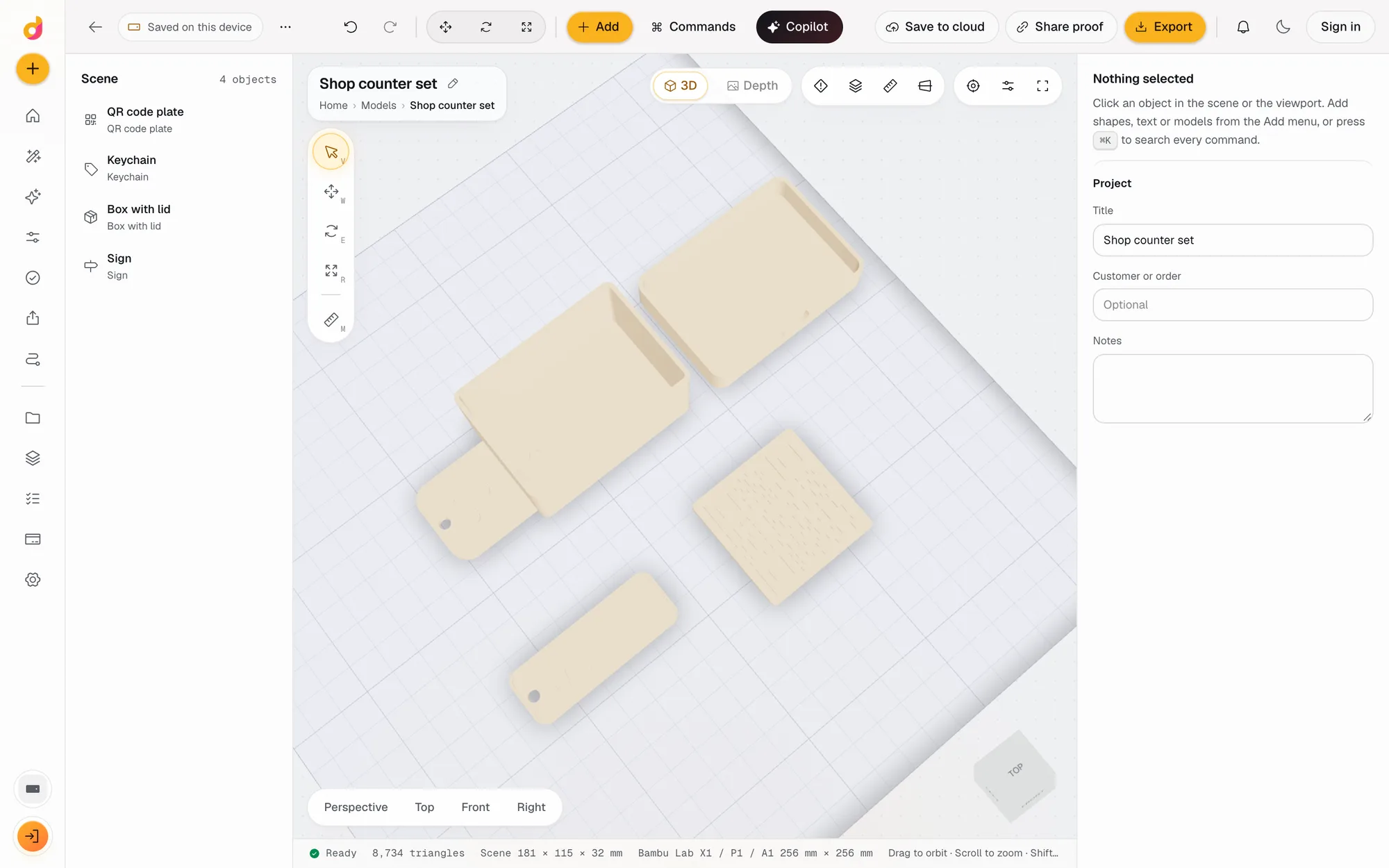
The bin is a normal solid in the scene, so everything else in Studio works on it. Emboss a name on the front with the STL editor text tool, cut a slot for a specific tool with a boolean, or check its weight and print time with the print checks before you slice. The other parametric parts sit on the same build plate.
Questions
What is Gridfinity?
Gridfinity is an open, modular storage system for 3D printers, created by Zack Freedman. Bins of any size sit on a baseplate with a 42 mm grid, so they stay put in a drawer and can be rearranged. Anyone can make and share parts for it.
Do these bins fit other Gridfinity baseplates?
They are built to the published dimensions: 42 mm grid, 41.5 mm per unit at the top of the foot, the 0.8, 1.8 and 2.15 mm foot profile and 7 mm height units. So they are made to drop into any standard baseplate, and standard bins fit the baseplate made here.
What magnets do Gridfinity bins use?
6 x 2 mm disc magnets, 6 mm across and 2 mm thick. The holes here are 6.5 mm across and 2.4 mm deep, the size the gridfinity-rebuilt reference uses, so the magnet presses in with a little room for glue.
How tall is a Gridfinity bin?
Height counts 7 mm units, base included. A 3 unit bin is 21 mm to the top of the wall; the stacking lip adds 4.4 mm so another bin can sit on top. Turn the lip off for a bin that has nothing stacked on it.
My printer bed is too small for the baseplate. What do I do?
Make several smaller baseplates. Each one is exactly 42 mm per cell on the outside, so a 4 x 4 and a 2 x 4 sit side by side as a 6 x 4 grid. A 6 x 6 baseplate is 252 mm square.
Is the Gridfinity generator free?
Yes. Making, editing and exporting bins and baseplates is free and runs in your browser. Nothing is uploaded and no credits are used.
Also in Depthue Studio
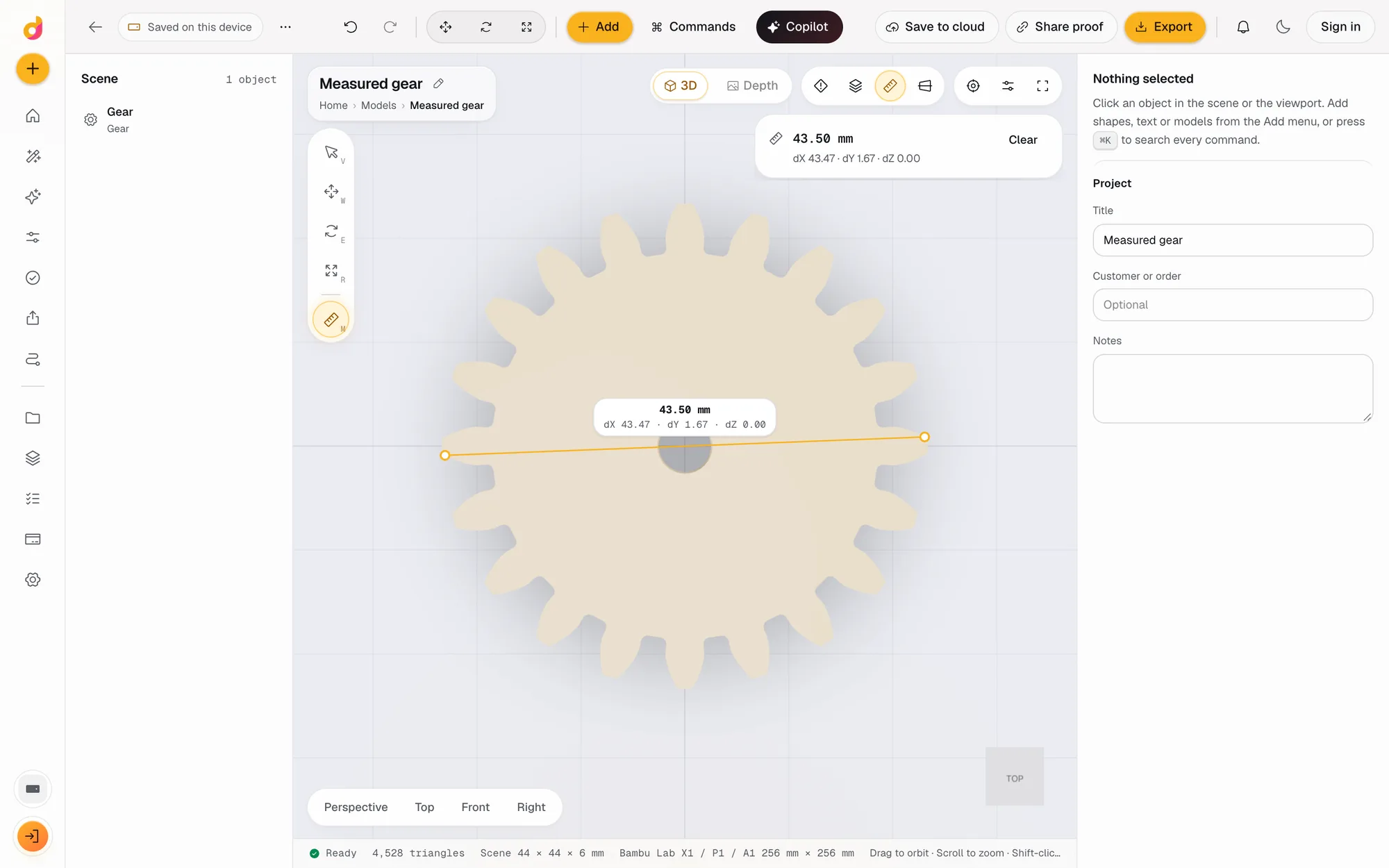
- Parametric model makerMake printable keychains, name signs, boxes with lids, vases, QR plates and gears from a few settings in mm, then edit and export STL or 3MF. Free.See how it works
 STL editorEdit STL files online: scale to exact millimetres, cut, hollow, combine, add text and holes, repair and simplify, then export STL or 3MF. Free, in your browser.See how it works
 STL checkerCheck an STL before printing: closed solid, plate fit, overhangs, thin walls, volume, mass and a print estimate in grams, time and cost. Free, in your browser.See how it works
Read next
3D printing
How Much Does 3D Printing Cost? Real Numbers, and How to Price Prints to Sell
What a 3D print costs at home or from a service: filament, power, wear and failures, resin vs FDM, and a pricing formula with Etsy fees for prints you sell.
October 8, 2026 7 min read
3D printing
How to Edit an STL File: The Right Free Tool for Each Change
How to edit an STL file for free: scale, cut, add text, combine parts or cut holes in your slicer, Tinkercad, Blender, Fusion or FreeCAD, matched to the job.
November 2, 2026 11 min read
Open the Gridfinity generator.
It runs in your browser and the free plan needs no card. Paid plans from $5 a month add credits, storage and projects.