How Much Does 3D Printing Cost? Real Numbers, and How to Price Prints to Sell
What a 3D print costs at home or from a service: filament, power, wear and failures, resin vs FDM, and a pricing formula with Etsy fees for prints you sell.
By Depthue Lab7 min read
A small PLA print made at home usually costs $1 to $5. Filament runs about $0.016 to $0.030 per gram at October 2026 store prices, and a desktop printer burns less than 2 cents of electricity an hour. A print service charges more because its quote also pays for machine time, labor, finishing and shipping, and if you sell prints, your time and the platform's fees outweigh the plastic.
Below: each cost line with current prices, three worked examples, what services charge for, resin against FDM, and a pricing formula with Etsy's fees built in.
What a print costs at home
Four lines make up the cost of the print itself: filament, electricity, printer wear and failed prints. Your own time comes on top, and it matters most when you sell.
Filament: price per gram
| Filament | Store price (October 2026) | Per gram |
|---|---|---|
| Bambu Lab PLA Basic, 1 kg refill | $15.99 | $0.016 |
| Bambu Lab PLA Basic, 1 kg with spool | $18.99 | $0.019 |
| Bambu Lab PLA Basic, 10 or more rolls | $11.19 a roll | $0.011 |
| Polymaker PolyLite PLA, 1 kg | $19.99 | $0.020 |
| Polymaker PolyLite PLA, 5 kg | $79.99 | $0.016 |
| Prusament PLA, 1 kg | $29.99 | $0.030 |
Prices are each brand's own store price in US dollars, before shipping and tax.
Your slicer reports the grams for every plate, including supports and purge. If you only have the model, open it in the free STL viewer: it estimates the weight in PLA at 100 percent infill, which is the most a solid print of that STL file can weigh. A normal print with walls and sparse infill weighs less.
Electricity
Energy in kWh is watts times hours divided by 1000. Bambu Lab publishes measured averages for its printers on PLA, and at 18.31 cents per kWh, the EIA's preliminary US average residential price for July 2026, they work out to:
| Printer | Average power on PLA | Cost per hour |
|---|---|---|
| Bambu Lab A1 mini | 80 W | 1.5 cents |
| Bambu Lab A1 | 95 W | 1.7 cents |
| Bambu Lab P1S | 105 W | 1.9 cents |
| Bambu Lab H2D | 197 W | 3.6 cents |
Bambu measured the A and P series on short PLA test prints, so treat these as a guide and use the rate on your own bill. Even a 10 hour print on an A1 uses under 20 cents of power.
Printer wear
Nozzles, build plates, belts and fans wear out, and eventually the printer does. The simple way to charge for it is an hourly rate: the printer's price spread over the hours you expect from it. A Bambu Lab A1 costs $299 (October 2026); spread over 3,000 print hours, that is $0.10 an hour. The 3,000 hours is our assumption, not a spec. Pick your own number, and fold in the parts you replace.
Failed prints
Every failed print is filament, power and printer time you pay for twice. Add an allowance based on your real failure rate: if one print in ten fails, add about 11 percent; if one in five fails, add 25 percent. We use 10 percent in the examples below.
Worked examples
These three examples use the same assumptions so you can see where the money goes. The grams and hours are example values, not measurements; replace them with your slicer's numbers.
Assumptions: Bambu Lab A1 at 95 W, Bambu PLA Basic at $18.99 per kg ($0.019 per gram), electricity at 18.31 cents per kWh, wear at $0.10 per hour, 10 percent failure allowance.
| Example print | Filament | Time | Filament cost | Power | Wear | Failures | Total |
|---|---|---|---|---|---|---|---|
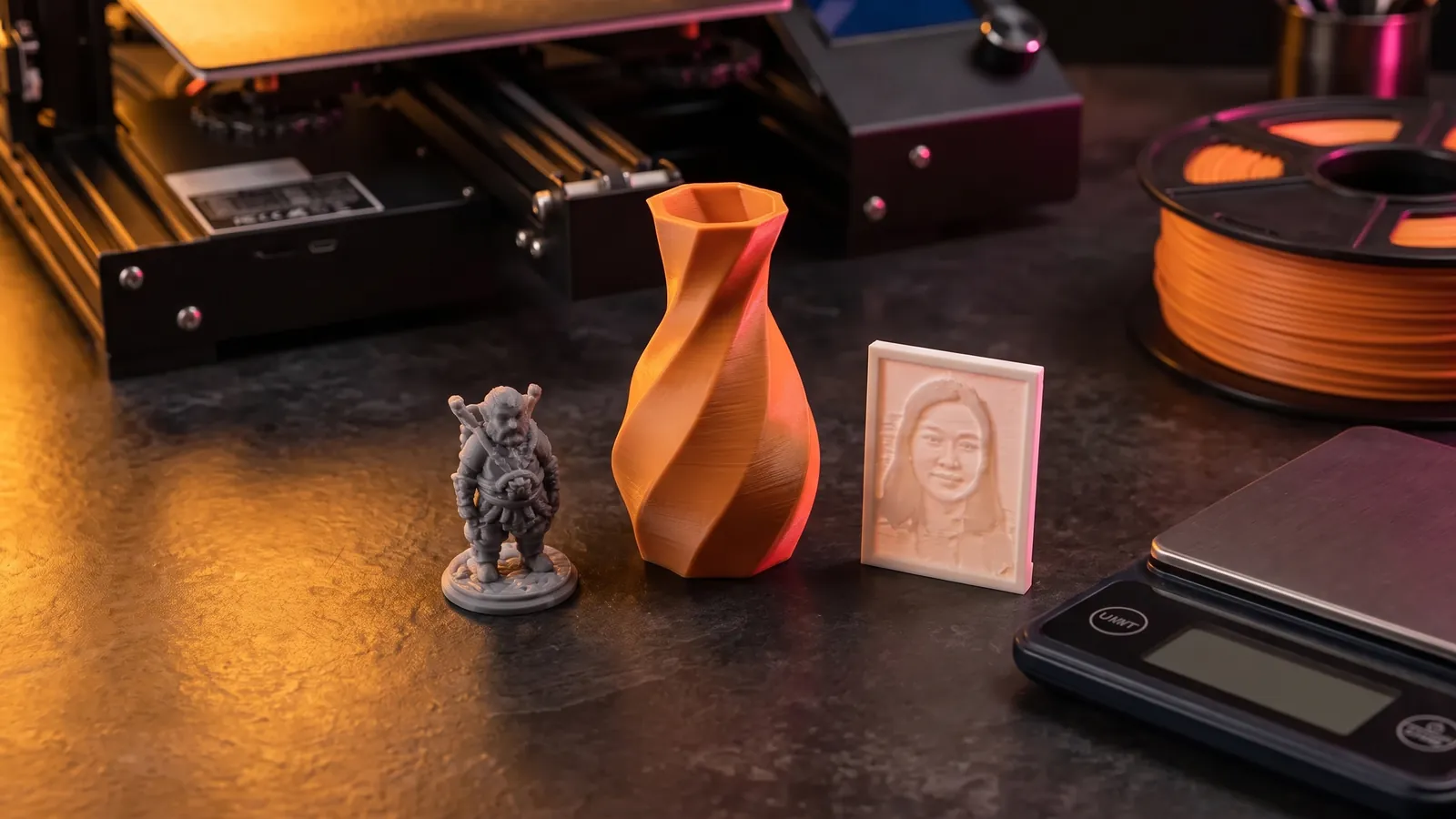
| Small figure, about 80 mm tall | 30 g | 3 h | $0.57 | $0.05 | $0.30 | $0.09 | $1.01 |
| Lithophane, 100 by 150 mm | 40 g | 4 h | $0.76 | $0.07 | $0.40 | $0.12 | $1.35 |
| Planter, about 150 mm across | 150 g | 7 h | $2.85 | $0.12 | $0.70 | $0.37 | $4.04 |
The pattern: on small, slow prints, wear adds about half the filament cost again. On big prints, filament dominates. Electricity barely registers.
A lithophane prints at 100 percent infill with fine layers, so it takes longer than its weight suggests. Make one with the free lithophane maker and the settings in how to make a lithophane.
Calculate your own print
The calculator does the same sums for any print. Drop an STL, 3MF or OBJ to estimate grams and print time, or type your slicer's numbers, then add electricity, wear, failures, labor, packaging and marketplace fees.
What a print service charges for
A service or marketplace quotes per part, and the quote covers much more than plastic:
- Material and volume. Bigger parts use more material, and engineering materials cost more than PLA.
- Process and machine time. FDM, resin (SLA) and powder processes (SLS, MJF) run on different machines at different rates.
- Finishing. Support removal, sanding, dyeing and painting are labor. When JLC3DP updated its prices in July 2026, it cut several material prices (PLA-P by 18 percent) but raised spray painting by 16.67 percent, citing higher labor and material costs.
- Quantity and minimums. Check for a minimum order value or a handling fee before you order one small part.
- Shipping and lead time. For a single small part, shipping can cost more than the print.
Few services publish full price lists. JLC3DP lists starting prices of $0.30 for SLA resin and $1.00 for FDM, MJF and SLS (October 2026); the real number comes from its instant quote. Craftcloud publishes no prices: it compares offers from more than 150 services, tailored to your location, and states that it has no minimum order. Upload the same file to two or three services and compare the totals, shipping included.
Resin vs FDM: which costs more?
| Cost line | FDM (PLA) | Resin |
|---|---|---|
| Material | $0.016 to $0.030 per gram (table above) | ELEGOO Standard Resin V2.0: $19.99 per kg, about $0.020 per gram. Formlabs Grey Resin V5: $79 per litre |
| Wear parts | Nozzles, build plates | Release film (ELEGOO: $24.99 for five FEP films for the Mars 4, 5 and 5 Ultra) and the LCD screen ($84.99 for a Mars 5 Ultra) |
| Consumables | Little beyond filament | Washing liquid or water-washable resin, gloves, paper towels |
| Hands-on time | Remove from plate, trim supports | Wash, cure, remove supports, sand off support marks |
Per gram, hobby resin and PLA cost about the same. Resin costs more per finished part because of washing, film and screen wear, the resin that goes into supports, and the extra handling. It earns that back on small, detailed parts such as miniatures and jewelry masters, where FDM cannot match the detail. For anything large or functional, FDM is cheaper.
How to price 3D prints to sell
Price from your costs, not from the cheapest listing you can find:
Price = (print cost + labor + packaging + profit + fixed fees) ÷ (1 - percentage fees)
- Print cost: filament, power, wear and failures, as above.
- Labor: your hands-on minutes times an hourly rate. Count slicing, plate removal, cleanup, packing and customer messages.
- Packaging: box, padding, label.
- Profit: what you want to keep per sale.
- Fees: the platform's per-order fees and percentages.
Etsy's fees for US sellers (October 2026)
| Fee | Amount | Charged on |
|---|---|---|
| Listing | $0.20 | Each listing for 4 months. A multi-quantity listing renews for another $0.20 when one sells |
| Transaction | 6.5% | The order total, including shipping and gift wrap you charge |
| Payment processing | 3% + $0.25 | The order total, including shipping and sales tax |
| Offsite Ads | 15%, or 12% once your shop has made $10,000 in a 365-day period | Only orders from a buyer who clicked an Etsy ad off Etsy within 30 days. Capped at $100 per order |
| Currency conversion | 2.5% | Payouts converted to a different currency |
Shops that have never made $10,000 in a 365-day period can opt out of Offsite Ads. Once you pass that, you are in for the life of the shop.
Worked example: pricing the lithophane
Take the $1.35 lithophane from above and sell it on Etsy, with shipping charged separately:
| Line | Amount |
|---|---|
| Print cost | $1.35 |
| Labor: 15 minutes at $20 an hour | $5.00 |
| Packaging | $1.50 |
| Profit you want | $6.00 |
| Fixed fees: listing $0.20 + processing $0.25 | $0.45 |
| Subtotal | $14.30 |
| Divided by 0.905 (6.5% + 3% = 9.5% in fees) | $15.80 |
List it at $16. At that price Etsy takes $1.97, and you keep $6.18 after costs. If the order comes through an Offsite Ad, the 15 percent fee takes another $2.40 and your profit falls to $3.78. To keep $6 even on those orders, you would need about $19.
Common pricing mistakes
- Pricing on filament alone. The plastic in that lithophane is $0.76 of a $16 sale. Time and fees are the real costs.
- Forgetting that fees apply to shipping. Etsy's 9.5 percent also comes out of the postage you charge, so price shipping at postage divided by 0.905.
- Not paying yourself. Count slicing, post-processing, packing and messages, not just the print. Time them once and price them in.
- No failure allowance. A failed 7 hour planter costs $3.67 in plastic, power and wear before you start the reprint.
- Ignoring Offsite Ads. Plan for the 15 percent on some orders, or price for it.
- Selling someone else's model without a licence. Many free models are licensed for non-commercial use only. Check the licence before you list prints of them.
Is 3D printing cheaper than buying?
For custom parts, replacement clips and brackets, and things you cannot buy at all, yes: the plastic costs cents to a few dollars. For mass-produced plastic goods, often no. A factory moulds them for less than your printer hours, failures and time are worth. Price it first, then decide.
Next step
Weigh your model in the STL viewer, take the hours from your slicer, and run both through the 3D print cost calculator with your own electricity rate and failure rate. If the file will not slice cleanly, fix it before you price it: see how to fix STL files.
Free tools for this job
Frequently asked questions
How much does 3D printing cost?
At home, a small PLA print usually costs $1 to $5 once filament, electricity and printer wear are counted. Filament runs about $0.016 to $0.030 per gram at October 2026 store prices. A print service costs more because the quote also covers machine time, labor, finishing and shipping.
What is the typical cost of a 3D print?
In our worked examples on a Bambu Lab A1, a 30 g figure costs $1.01, a 100 by 150 mm lithophane $1.35 and a 150 g planter $4.04. That includes filament, power, printer wear and a 10 percent allowance for failed prints, but not your time.
How do I calculate the cost of a 3D print?
Multiply grams by the price per gram, add hours times printer watts divided by 1000 times your electricity price per kWh, add hours times a wear rate, then add a percentage for failed prints. Your slicer gives you the grams and hours.
What is a good price to charge for 3D printing?
Add up print cost, your hands-on time, packaging and the profit you want, add the platform's fixed fees, then divide by one minus its percentage fees. On Etsy that means adding $0.45 and dividing by 0.905, before any Offsite Ads fee.
Is 3D printing cheaper than buying?
For custom parts, replacements and things you cannot buy, usually yes: the plastic in a small part costs cents to a few dollars. For mass-produced plastic goods, often no, once you count printer time, failures and your own labor.
Sources
- Bambu Lab Store (US), PLA Basic filament
- Prusa Research, Prusament PLA
- Polymaker, PolyLite PLA
- Bambu Lab Wiki, printer and AMS power parameters
- U.S. Energy Information Administration, Electric Power Monthly, Table 5.6.A
- Bambu Lab Store (US), A1 3D printer
- ELEGOO (US), Standard Resin V2.0
- Formlabs, Grey Resin V5 (Form 4)
- ELEGOO (US), FEP Film for Mars 4/5/5 Ultra
- ELEGOO (US), LCD Screen for Mars 5 Ultra
- JLC3DP, online 3D printing service
- JLC3DP, materials and finishing pricing update (July 2026)
- Craftcloud, 3D printing marketplace
- Etsy Help, What are the Fees and Taxes for Selling on Etsy?
- Etsy Help, What are Payment Processing Fees for Selling on Etsy?
- Etsy Help, How Etsy's Offsite Ads Work
- Etsy Help, Fees and Listing Multiple Quantities