
Free tool
3D print cost calculator
Drop a model or type your slicer's numbers. Get the true cost of the print and a price that leaves a profit.
Runs in your browser. Nothing is uploaded.
How to use it
1Get grams and time
Type the filament grams and print time from your slicer, or drop an STL, 3MF or OBJ for an estimate.
2Set material and machine
Pick the material, then enter what the spool cost, your printer's price and power draw, and your electricity rate.
3Add what people forget
Failed prints, prep and post-processing time, packaging and shipping. Set the batch size to share setup time across units.
4Choose your profit
Pick a markup or a target margin and your marketplace fees. The calculator solves the price that keeps that profit after fees.
5Copy the quote
Copy a plain text quote, or a link that reopens the calculator with the same settings.
To calculate the cost of a 3D print, add the filament (grams × price per kg ÷ 1,000), electricity (watts ÷ 1,000 × hours × price per kWh), printer wear (printer price ÷ lifetime hours × print hours), the expected cost of failed prints, and your labor and packaging. To set a price, solve price = (cost + fixed fees + profit) ÷ (1 − percentage fees), so marketplace fees are paid out of the price, not your profit.
A worked example
These are hypothetical numbers, not market prices. A 60 g PLA desk organizer prints in 3 hours. The spool cost $22 per kg, the $600 printer should last 5,000 print hours, it averages 120 W, and power costs $0.18 per kWh.
| Cost line | Math | Per unit |
|---|---|---|
| Filament | 60 g × $22 ÷ 1,000 | $1.32 |
| Electricity | 0.12 kW × 3 h × $0.18 | $0.06 |
| Printer wear | $600 ÷ 5,000 h × 3 h | $0.36 |
| Maintenance | $0.05 per hour × 3 h | $0.15 |
| Failed prints | 5% rate: 5/95 of the lines above | $0.10 |
| Labor | 15 minutes at $20 per hour | $5.00 |
| Packaging | Box and filler | $0.50 |
| Cost per unit | $7.49 |
With a 100% markup and no fees, the price is $14.99. Sold on Etsy in the US, keeping the same $7.49 profit takes a price of $17.06, because 9.5% of the price and $0.45 per order go to fees.
What each cost line covers
| Line | What it is | What people forget |
|---|---|---|
| Filament | The slicer's grams, supports included | Purge and prime tower on multicolor prints |
| Electricity | Average draw while printing | Bed heat-up and heated enclosures |
| Printer wear | Printer and upgrades over its print hours | The AMS, spare hotends and plates |
| Failed prints | Expected reprints at your failure rate | Reprints fail too: a 10% rate adds 11.1% |
| Labor | Prep per batch, post-processing per unit | Slicing, support removal, sanding, packing |
| Fees | Marketplace percentage and fixed fees | They apply to the shipping the buyer pays |
Where to find grams and time in your slicer
Slice the model, then:
- Bambu Studio and OrcaSlicer: in the Preview, the Total Estimation block lists Total Filament in meters and grams, and Total time. Color the Preview by Filament to see the Model, Flushed and Tower grams of each filament.
- PrusaSlicer: the Sliced Info box in the right panel shows Used Filament (g) and Estimated printing time, with a wipe tower line on multi-material prints.
- Cura: the panel at the bottom right shows the print time and the filament in grams and meters. Hover the information icon for the time and material estimation.
Checked in October 2026 against Bambu Studio 02.08.02, OrcaSlicer 2.4.2, PrusaSlicer 2.9.6 and Cura 5.13.
How to choose a markup
Markup is profit as a share of cost. Margin is profit as a share of the price. Margin = markup ÷ (1 + markup), so a 100% markup is a 50% margin and a 50% markup is a 33.3% margin. Decide what an hour of your printer and an hour of your time must earn, then compare the price with similar listings.
Fees come on top. As of October 2026, Etsy charges US sellers a 6.5% transaction fee on the item and shipping, payment processing of 3% + $0.25 per order, and a $0.20 listing fee, according to its Fees & Payments Policy and Help Center. The 3% also applies to sales tax, which the calculator leaves out. Offsite Ads add 15% on the orders they bring, or 12% once a shop passes $10,000 in yearly sales.
Resin and FDM cost differently
Resin is sold by the litre or kilogram and sliced in millilitres, so the calculator switches to ml and a price per litre. Resin print time follows height, not volume: each layer takes the same exposure and lift time however much of the plate it covers, so a full plate takes about as long as one part. Gloves, IPA and FEP film belong in maintenance. FDM time follows the volume extruded, so a batch takes roughly the sum of its parts.
Estimating from a model
Drop an STL, 3MF or OBJ and the calculator measures its volume and surface area. Walls and solid top and bottom layers become one shell over the whole surface, as thick as walls × line width or layers × layer height, whichever is larger. Infill fills the rest at your density. Only closed meshes give a true volume: an open one gets a warning, and the STL repair tool can close it. Check the size first in the online STL viewer, and plan color swaps for reliefs with the filament painting planner.
Default densities come from manufacturers' datasheets: PLA 1.24, PETG 1.27, ASA 1.07, PC 1.22, TPU 1.25 and nylon (PA11) 1.02 g/cm³ from Prusament, ABS 1.05 and PLA-CF 1.22 from Bambu Lab, and resin 1.13 from Anycubic's Colored UV Resin.
Questions
How do you calculate the cost of a 3D print?
Add filament (grams × price per kg ÷ 1,000), electricity (kW × hours × price per kWh), printer wear (printer price ÷ lifetime hours × print hours), the expected cost of failed prints, your labor and packaging. Share setup time across every unit in the batch.
What is a good price to charge for 3D printing?
One that covers the full cost per unit, the marketplace fees and the profit you want. Solve it as price = (cost + fixed fees + profit) ÷ (1 − percentage fees), so the fees come out of the price instead of your profit.
How do I price my 3D models?
Price each printed model from its own numbers: grams and time from the slicer, the labor it takes, then your markup and fees. Compare the result with similar listings. If you are far above them, cut print time or labor before you cut your margin.
What is the typical cost of a 3D print?
It depends on grams, hours and labor more than on the filament price. In the example on this page, 60 g of PLA costs $1.32, but the print costs $7.49 once machine time, failures, 15 minutes of labor and packaging are counted. Run your own numbers.
How much electricity does a 3D printer use?
Average power × hours. A printer averaging 120 W for 3 hours uses 0.36 kWh, about 6 cents at the US average of 18.31 cents per kWh (EIA, July 2026).
How accurate is the estimate from a model?
It is an estimate. Walls and solid layers are treated as one shell over the whole surface, infill fills a share of the rest, and time comes from an average flow. For a quote, slice the model and type the slicer's grams and time.
Is my model uploaded?
No. The file is read in your browser, and its volume, surface area and size are measured on your device. Nothing is sent to a server.
Read next
3D printing
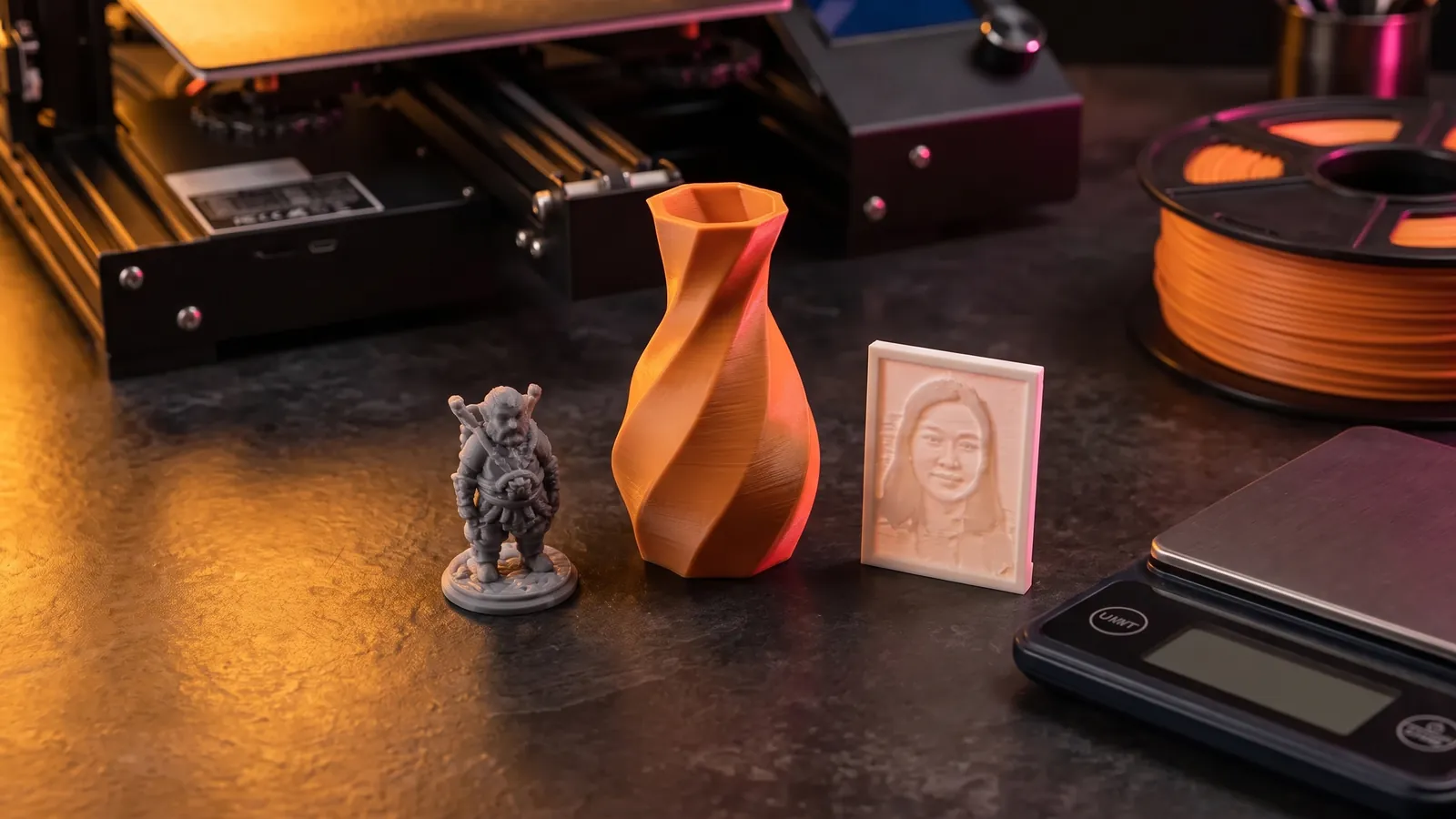
How Much Does 3D Printing Cost? Real Numbers, and How to Price Prints to Sell
What a 3D print costs at home or from a service: filament, power, wear and failures, resin vs FDM, and a pricing formula with Etsy fees for prints you sell.
October 8, 2026 7 min read

HueForge and lithophanes
How to Make a Lithophane From a Photo (Settings That Work)
How to make a lithophane from a photo: image choice, thickness, size, flat or curved panels, slicer settings for white PLA, and fixing flat or dark prints.
September 21, 2026 2 min read
HueForge and lithophanes
How to Plan Color Swap Heights for Filament Painting
Where to change filament in a HueForge-style painting: layer math, transmission distance, swap order, and adding color changes in Bambu Studio and OrcaSlicer.
September 21, 2026 2 min read