How to Make a Lithophane Lamp: Types, Lights, Sizing and Safety
Make a lithophane lamp, night light or light box: pick the shape and the LED, size the print with π × diameter, print it upright and power it safely.
By Depthue Lab8 min read
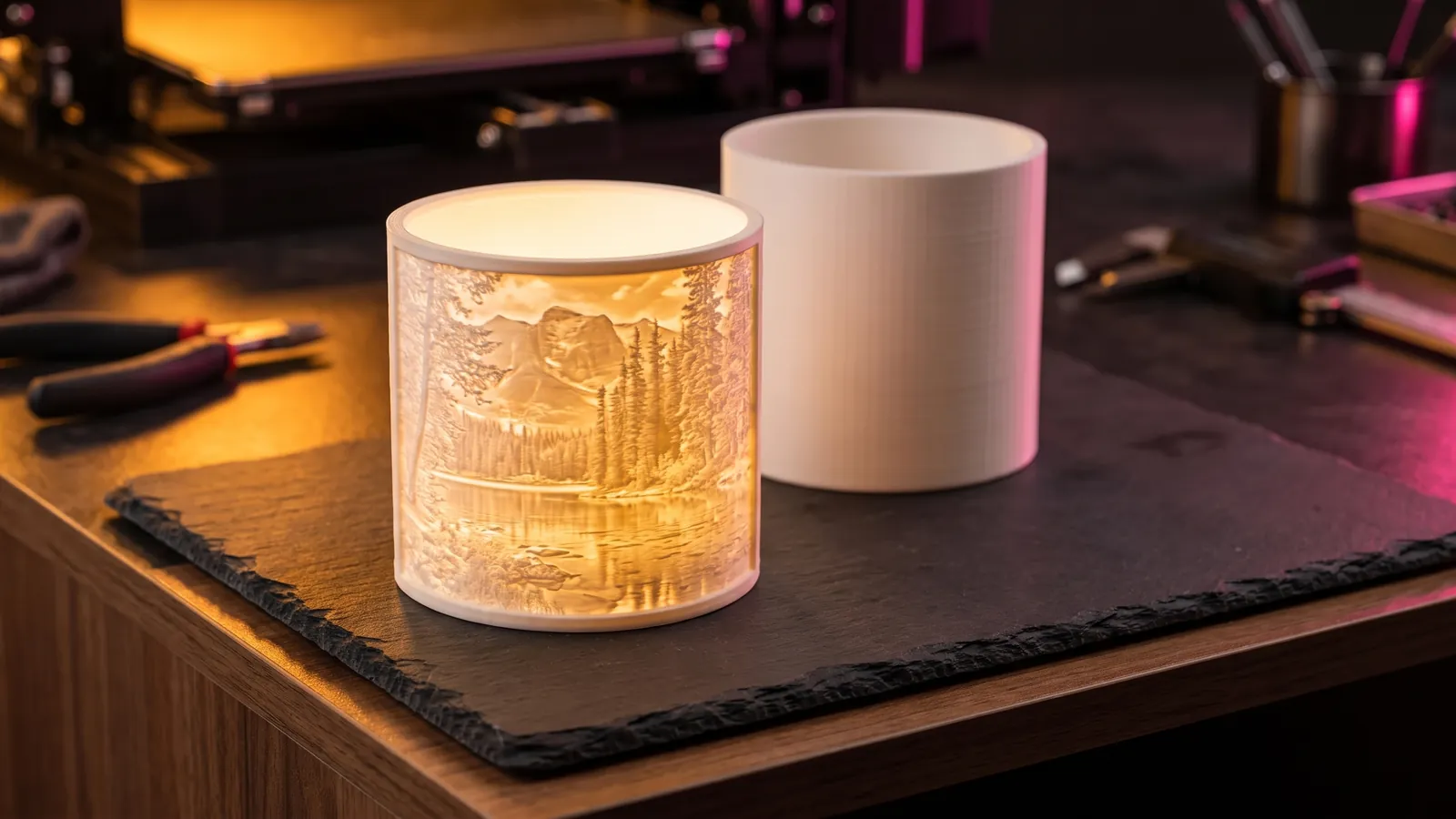
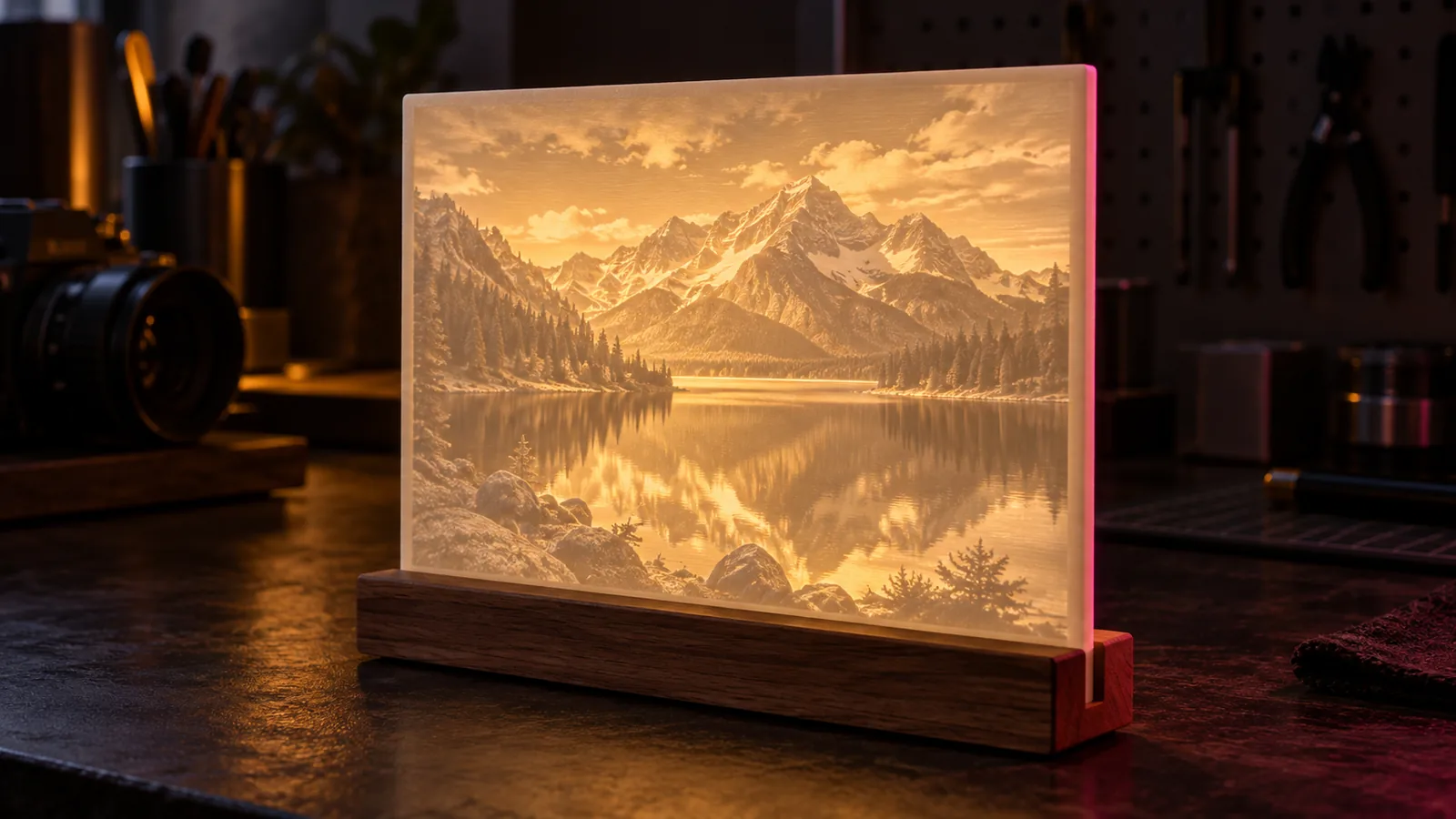
A lithophane lamp is a lithophane with a light inside or behind it: a flat panel in a light box, a curved panel around an LED tea light, a cylinder shade over a bulb, or a moon globe. Use LEDs only, because PLA starts to soften around 55 to 60 °C. For a cylinder, the flat image is π × the diameter wide, so an 80 mm lamp needs a 251 mm wide picture.
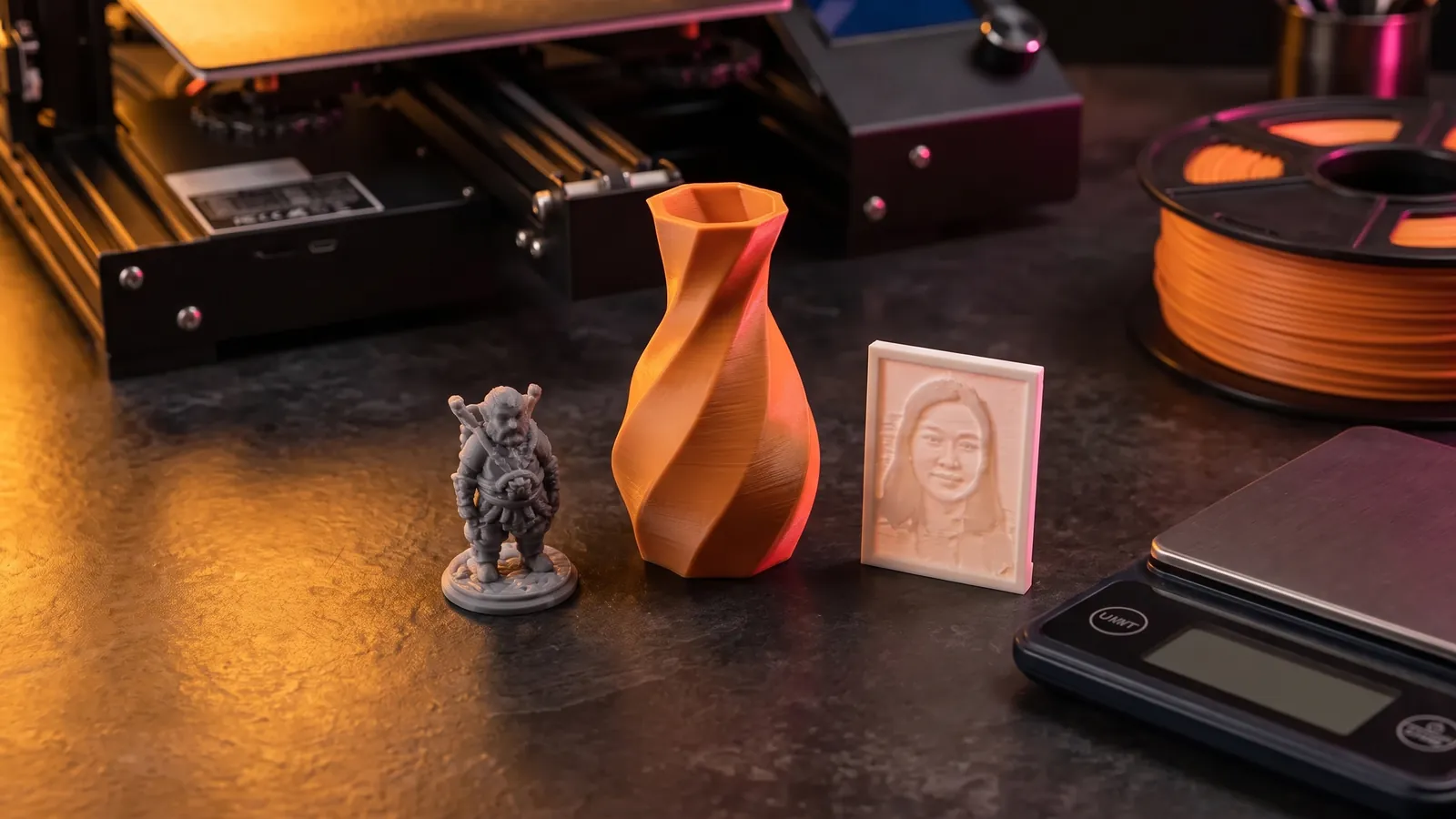
This guide covers the lamp. For the photo, thickness and slicer basics, read how to make a lithophane first.
Pick a lamp type
| Lamp type | Light source | Made with | Good to know |
|---|---|---|---|
| Flat panel in a light box or frame | LED board or panel behind it | Any lithophane maker, including our free tool | The easiest print. Bambu Lab's framed panels are 144 by 108 mm |
| Curved stand-up panel | LED tea light or puck behind it | Our free tool (curves from 30° to 300°), ItsLitho arc shape, LithophaneMaker.com curved maker | Stands on its own; leave the back open to reach the light |
| Cylinder lamp or shade | USB LED base, or an LED bulb in a lamp | Our free tool (closed 360° cylinder), ItsLitho cylinder with a lamp shade light holder, LithophaneMaker.com lamp maker | Needs a wide image: a panorama or several photos |
| Four-photo light box | A bulb socket inside | LithophaneMaker.com light box maker | Four photos: front, top, left and right |
| Moon or globe | Bulb or LED in the base | LithophaneMaker.com globe maker (optional moon background), ItsLitho sphere | A sphere distorts the image, and a color sheet cannot wrap it |
| Night light | Plug-in LED night light | LithophaneMaker.com night light maker, ItsLitho arc or sphere night light | The slot must fit your night light |
You rarely need a separate base. ItsLitho adds puck light holders, candle holders, night light holders and lamp shade light holders as attributes, and LithophaneMaker.com builds the socket mount, box or night light adapter into the model.
Choose the light source
Heat decides this. Prusament rates PLA's temperature resistance at 55 °C and says parts lose strength above 60 °C; Prusa's knowledge base says PLA gets soft and deforms above 60 °C. An incandescent bulb turns less than 5 percent of its energy into visible light and releases the rest as heat. An LED gives the 800 lumens of a 60 W incandescent bulb from about 9 W. Use LEDs, and keep a gap between light and plastic.
| Light | Power | Best for | Watch out for |
|---|---|---|---|
| USB LED base or backlight board | 5 V from a USB port or charger | Light boxes, framed panels, cylinders, globes | Pick a dimmable one. Bambu Lab's kit: 48 LEDs per board, 5 V, 2 A, long-press dimming |
| LED puck light | Battery or plug-in, by model | Cylinders and boxes lit from below | ItsLitho has a puck light holder attribute |
| LED strip | Varies by kit | Large boxes and frames | A bare LED makes hotspots; diffuse it |
| LED tea light | Battery | Curved panels, votives, small ornaments | Brightness varies a lot |
| LED bulb with an E12, E14, E26 or E27 base | Mains, through a certified lamp | Shades over an existing lamp | Match the shade's mount to your socket |
| Plug-in LED night light | Mains plug | Night light lithophanes | The slot must fit the light |
Tea lights are worth testing. LithophaneMaker.com compared two: one bright enough for a lit room ran 30 hours on its battery, while a 100-hour model was too dim for a bright room.
The number in a bulb base is its thread diameter in millimetres. E26 is the standard base in North America and E27 in Europe, and they usually interchange. E12 is the North American candelabra base, and E14 is the small European base used in chandeliers and night lamps.
Color temperature and brightness
- Warm white, 2700 to 3000 K, gives a white lithophane a warm, yellowish glow. ItsLitho sells a 3000 K USB LED base for lamp-style, cylinder and sphere lithophanes.
- Cool white or daylight, 5000 to 6500 K, shows the most neutral image. American Filament recommends a cool white backlight. Color lithophanes need this range: QIDI notes that a 2700 K source skews blues and greens toward olive.
- Brightness is lumens, not watts. More is not always better. A bare LED close to the print makes a hotspot with falloff toward the edges, while too far away loses the dark areas. Diffuse it, set the distance, or dim it.
- Tune thickness to your light. American Filament's thickness values change with the light source, so print their calibration tower and hold it in front of the light you will use.
Size the lithophane to the lamp
Cylinders: width = π × diameter
A cylinder lithophane is a flat image wrapped into a tube, so its width is the circumference: π × diameter. Generators do the math once you enter the diameter, and unless you crop, the photo's shape then sets the lamp's height. So plan the photo first.
| Lamp diameter | Flat image width | Image ratio for a 100 mm tall lamp |
|---|---|---|
| 60 mm | 188.5 mm | about 1.9 to 1 |
| 80 mm | 251.3 mm | about 2.5 to 1 |
| 100 mm | 314.2 mm | about 3.1 to 1 |
| 120 mm | 377.0 mm | about 3.8 to 1 |
That is panorama shape. ItsLitho suggests several images side by side unless you have a panorama, and LithophaneMaker.com's lamp maker joins 1 to 4 photos with spacing between them.
Partial curves
For a curve that does not close, width = π × diameter × arc ÷ 360. Our free tool works the other way: set the width and the curve angle, from 30° to 300°, and the radius follows. A 150 mm wide panel curved through 120° sits on a circle about 143 mm across. At 300°, the panel wraps most of the way around a tea light and leaves a gap at the back. For a closed votive or lamp, choose Cylinder: you set the circumference, the photo wraps once around, and the tool shows the bore and outside diameter. LithophaneMaker.com's curved maker also goes to a full 360°.
Shades on a lamp socket
Measure the socket first. ItsLitho's lamp connector takes the socket diameter as its fitter diameter and lets you use 3, 4 or 5 connectors. LithophaneMaker.com's shade has a ledge that sits between socket and bulb: make the ledge hole slightly larger than the bulb's metal base and the cylinder slightly larger than the socket.
Boxes, frames and night lights
- In LithophaneMaker.com's light box, the bulb must be shorter than the box depth minus two frame thicknesses.
- Building a box from four flat panels with butt joints: the front and back are the full outside width, and the two sides are that width minus twice the panel thickness.
- American Filament's starting night light is 80 by 105 mm with a frame of at least 5 mm, a 17 by 17 mm slot, a 1.8 mm adapter and 30 mm between light and lithophane. The slot defaults fit most plug-in night lights.
- Bambu Lab sizes its framed lithophanes at 144 by 108 mm to fit its frame and backlight board.
Make the lithophane
Our free lithophane maker makes flat panels, curves from 30° to 300° and closed 360° cylinders with a smooth bore and solid rims, so an LED puck or tea light slides inside. It runs in your browser and never uploads the photo. Set the width (the circumference, for a cylinder) in millimetres, then the thinnest and thickest points. For an 80 mm bore, enter 251 mm.
For a closed cylinder with a socket mount, a globe or a night light adapter, use ItsLitho or LithophaneMaker.com. Both are free, and both allow selling what you print.
Print settings for upright panels and cylinders
The full basics are in how to make a lithophane. What matters for lamps:
| Setting | Flat or curved panel | Cylinder or globe |
|---|---|---|
| Orientation | Upright, along the Y axis | Upright, as generated |
| Layer height | 0.12 mm with a 0.4 mm nozzle | 0.12 mm with a 0.4 mm nozzle |
| Image area | Solid: 99 to 100 percent infill, or 7 or more walls | Same |
| Wall generator | Classic | Arachne |
| Speed | 30 to 45 mm/s | 30 to 45 mm/s |
| Adhesion | 10 to 20 mm brim | Brim if the base is narrow |
| Supports | None for plain panels | Only where the shape needs them, touching the build plate |
ItsLitho prints lithophanes standing up because a printer resolves much more detail across a layer than between layers, and along the Y axis so a moving bed does not rock a tall panel. American Filament uses the Classic wall generator for flat pieces and Arachne for curved ones such as night lights, globes and lamp shades.
Before a full cylinder, print a short band of it. A 20 mm slice shows whether the socket fit and the thickness suit your light, in a fraction of the time.
Wiring and safety basics
- Default to USB. A 5 V USB LED base, board or puck keeps mains voltage out of your print. Bambu Lab's backlight kit runs on 5 V and comes with a USB cable that has an on/off switch.
- For mains light, use a certified lamp kit or an existing lamp, and make the lithophane the shade. Do not wire mains connections inside a printed part.
- LEDs only. No incandescent or halogen bulbs, and no real candles.
- Keep a gap. The bulb or board should not touch the plastic; American Filament's night light keeps 30 mm between light and lithophane. After an hour of running, feel the print near the light. If it is warm, add distance or use a lower power LED.
- If you sell lamps, ship them with a certified plug-in or USB light rather than one you assembled.
Selling lithophane lamps
Personalized lithophanes are popular gifts, and American Filament notes that many companies already sell them online. Before you list one:
- Work out the real cost. Run the print through the 3D print cost calculator: filament, power, printer wear, failed prints, labor, packaging, marketplace fees and your markup. Then add the light; Bambu Lab's backlight kit starts at $9.89 as of October 2026. The full breakdown is in how much 3D printing costs.
- Check the licence. ItsLitho's models are free for commercial use. LithophaneMaker.com lets you sell lithophanes made with it as long as you follow copyright law. Lithophane Maker Desktop's personal licence does not allow selling; its commercial licence is $199 lifetime or $69 a year as of October 2026. Depthue's free tools allow commercial use, and what you make with them is yours.
- Use photos you have rights to. For custom orders, that means the customer's own photos.
- Name the light. List the color temperature of the LED you ship, so the buyer knows whether to expect a warm or a neutral glow.
Next step
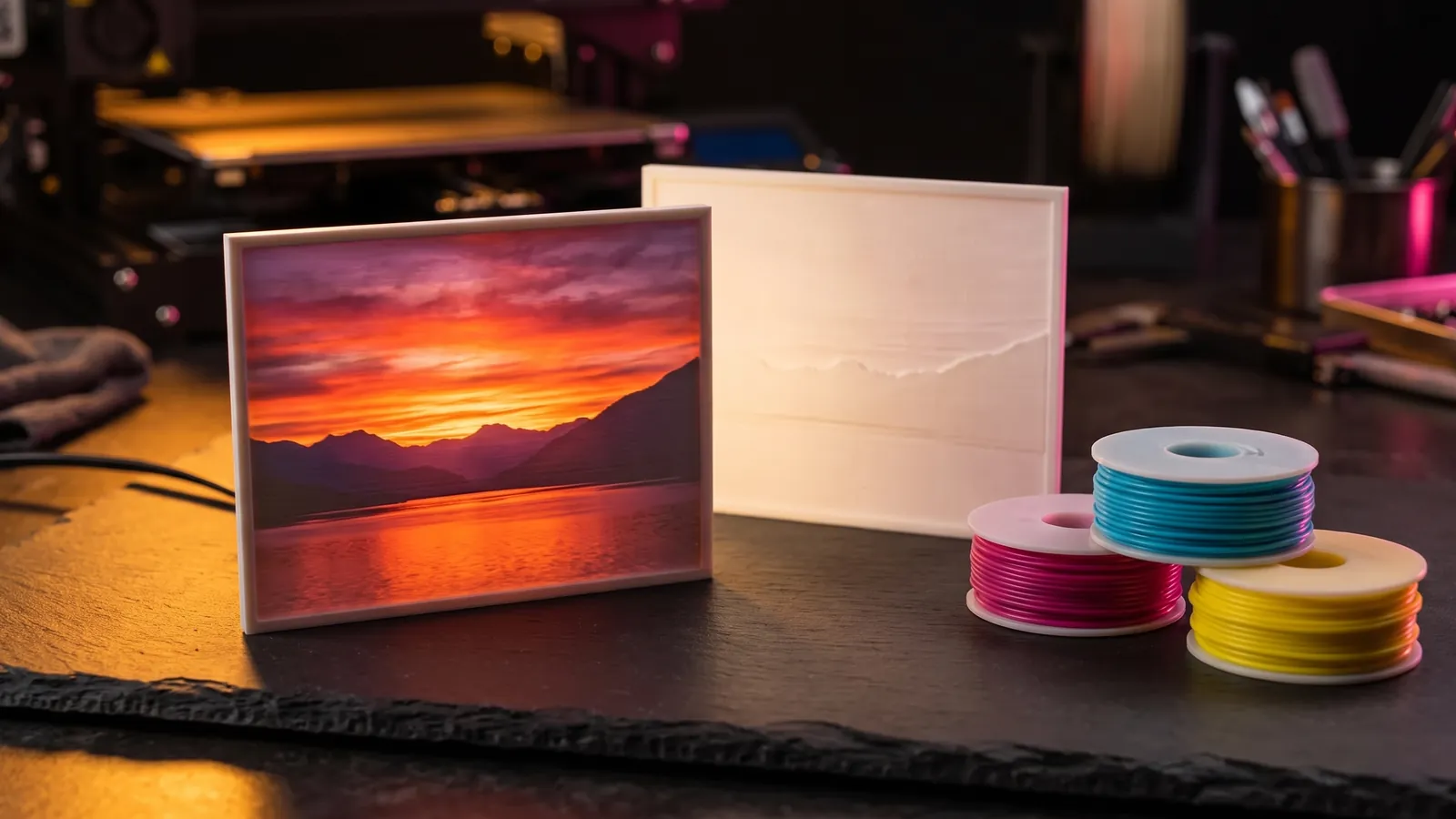
Print one panel at the size of your light box, light it with the exact LED you plan to use, and adjust the thickness before you commit to a full cylinder. Make the panel with the free lithophane maker. For color, read how to make a color lithophane.
Free tools for this job
Frequently asked questions
What light do you use for a lithophane lamp?
An LED: a USB LED base or backlight board, an LED puck, an LED tea light or an LED bulb. PLA softens above about 60 °C and an incandescent bulb releases more than 95 percent of its energy as heat, so avoid incandescent and halogen bulbs.
How big should a lithophane be for a lamp?
For a cylinder, the flat image is π × the diameter wide, so an 80 mm lamp needs a 251 mm wide image. Crop your photo, or several photos side by side, to that shape before you generate the model.
What color temperature is best for a lithophane lamp?
Warm white, 2700 to 3000 K, for a warm glow on a white lithophane. Cool white or daylight, 5000 to 6500 K, for a neutral image and for color lithophanes.
How do you make a lithophane light box?
Put a flat lithophane in front of a USB LED board, or print the whole box. LithophaneMaker.com's free light box maker builds a box from four photos (front, top, left and right) with a mount for a bulb socket inside.
Will a lithophane lamp melt?
Not with an LED and a gap. Prusament rates PLA to 55 °C and Prusa says it softens and deforms above 60 °C, so a hot incandescent bulb can warp it. American Filament's night light design keeps the light 30 mm from the lithophane.
Can I sell lithophane lamps?
Yes, with photos you have rights to and a generator that allows it. ItsLitho and LithophaneMaker.com allow selling, Lithophane Maker Desktop needs its commercial licence, and Depthue's free tools allow commercial use.
Sources
- LithophaneMaker.com, Lithophane makers
- LithophaneMaker.com, Lithophane Lamp Maker
- LithophaneMaker.com, Lithophane Light Box Maker
- LithophaneMaker.com, Curved Lithophane Maker
- LithophaneMaker.com, Lithophane Globe Maker
- LithophaneMaker.com, Night Light Lithophane Maker
- LithophaneMaker.com, Terms of use
- ItsLitho, Free online image to lithophane maker
- ItsLitho, How to make a 3D printed lithophane lamp shade
- ItsLitho, How to make a 3D printed color lithophane
- ItsLitho, Slicer settings for lithophanes
- ItsLitho, USB LED light base for lithophanes, 3000K warm white
- ItsLitho, Terms of use
- American Filament, Beginner's Guide to Printing Lithophanes
- American Filament, Lithophane Maker Desktop
- Bambu Lab Store, Lithophane LED Backlight Board Kit
- Bambu Lab Wiki, CMYK Lithophane Printing Guide
- QIDI Tech, The Mechanics of Multi-Material Color Lithophane Printing (July 2026)
- Prusament, PLA material page
- Prusa Knowledge Base, PLA
- Wikipedia, Incandescent light bulb
- FTC Consumer Advice, Shopping for light bulbs
- Wikipedia, Color temperature
- Wikipedia, Edison screw